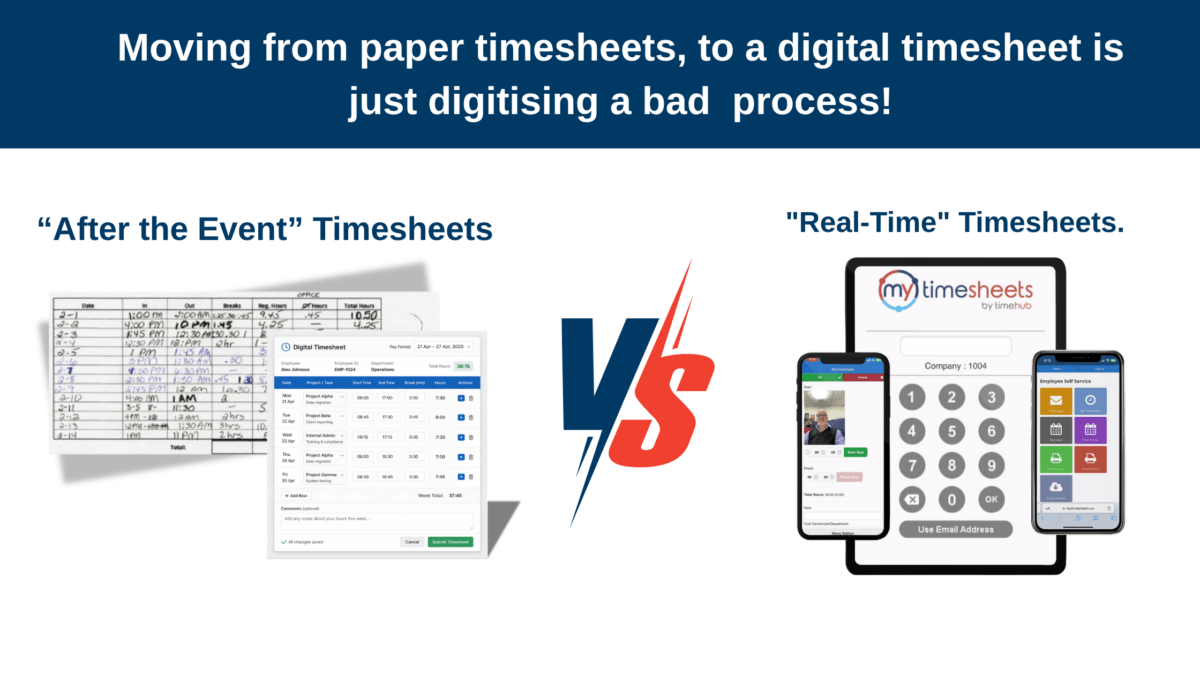
How you capture employee time matters more than you think. Are you just digitising a bad process?
While many businesses are moving on from paper timesheets to digital solutions, many are still stuck with the same old problems… just in digital form.
They’re using “after the event” tools. And that’s where the real problem starts.
Because the issue isn’t paper vs digital. It’s when the data is captured.
What is an “after-the-event” timesheet?
An “after the event” system is any process where employees:
- Manually record their hours at the end of the day.
- Fill in timesheets at the end of the week.
- Reconstruct what they think they worked.
Even if this is done in a polished digital app, it’s still based on memory. And memory is not a reliable data source.
What is "real-time" time capture?
Real-time systems like MyTimesheets flip this on its head.
Instead of recalling hours later, employees:
- Clock in when they start.
- Clock out when they finish.
- Capture breaks and job changes as they happen.
The result is simple:
You record what actually happened, not what someone remembers happened.
Why this difference matters
At a glance, both approaches might seem fine. People still get paid. Payroll still runs.
But under the surface, the differences are significant.
1. Accuracy: Memory vs reality
After the event:
- Rounded start times.
- Missed breaks.
- Estimated finish times.
- “Close enough” entries.
Real-time:
- Exact timestamps
- No guesswork
- No reconstruction
Small inaccuracies add up fast. This is where TimeCreep quietly eats into your payroll.
2. Trust: Doubt vs confidence
After the event:
- Managers question the data.
- Employees feel scrutinised.
- Disputes become common.
Real-time:
- Transparent records.
- Shared source of truth.
- Fewer disagreements.
Trust works both ways. And it starts with reliable data.
3. Payroll risk: Hidden vs visible
After the event:
- Errors only show up after payroll is processed.
- Fixing mistakes means rework.
- Compliance risks increase.
Real-time:
- Issues are visible immediately.
- Exceptions can be managed early.
- Clean data flows into payroll.
You move from reactive to proactive.
4. Admin time: Manual vs automated
After the event:
- Checking timesheets.
- Chasing missing entries.
- Interpreting unclear data.
- Re-keying into payroll.
Real-time:
- Minimal intervention.
- Data flows automatically.
- Managers review, not rebuild.
Less admin. More control.
5. Cost: Invisible vs measurable
After the event, systems create hidden costs:
- Overpaid hours from manual rounding.
- Time theft.
- Admin overhead.
- Payroll corrections.
These don’t show up as a line item. But they are very real.
Real-time systems expose and eliminate these losses.
The biggest myth
“Digital timesheets solve the problem.” They don’t.
If they’re filled in after the fact, all you’ve done is: Digitise the same old problem.
The real shift
This isn’t about software.
It’s about moving from:
- Recollection → Reality
- Estimation → Evidence
- Cleanup → Control
That’s the shift that changes everything.
Final thought
If you’re still relying on after-the-event timesheets, even digital ones, you’re operating on delayed, reconstructed data.
And that creates:
- Risk
- Cost
- Friction
"Real-time" time capture removes all three.
Because when it comes to payroll and attendance…
The detail isn’t just important. It’s everything.